How to Choose the Best Fish Box Coolers?

Choosing the best Fish Box Coolers requires more than comparing volume, price, and exterior appearance. Seafood quality depends on temperature stability, drainage, insulation, handling speed, and cleaning access. The FAO’s The State of World Fisheries and Aquaculture 2024 reported 185 million tonnes of aquatic animal production in 2022. Much of this product moves through chilled supply chains, where small temperature failures can create significant quality losses.

The FDA Food Code recommends holding potentially hazardous foods at 41°F (5°C) or below. Therefore, a reliable cooler should support that target during loading, transport, and short-term storage. The National Fisheries Institute also emphasizes rapid chilling as a practical seafood-handling priority. Dr. Michael Jahncke, director of Virginia Tech’s Seafood Agricultural Research and Extension Center, has stated, “Temperature control is the key to maintaining seafood quality and safety.” That principle sounds simple. Real operations are less tidy.

A strong Fish Box Coolers evaluation should examine wall thickness, gasket performance, lid fit, internal volume, ice-to-product ratio, and meltwater control. A box that looks rugged may still lose cooling quickly under direct sunlight. A lightweight model may be easier to carry, yet less durable during repeated loading. The best choice depends on species, trip length, ambient temperature, and cleaning routines. The FAO report provides global context, but it cannot select a cooler for every dock or delivery route. Careful trials matter. Measure internal temperature with a calibrated thermometer, record results, and question assumptions before purchasing in bulk.
How to Choose the Best Fish Box Coolers?

Understanding Fish Box Cooler Types and Their Primary Uses

How to Choose the Best Fish Box Coolers?

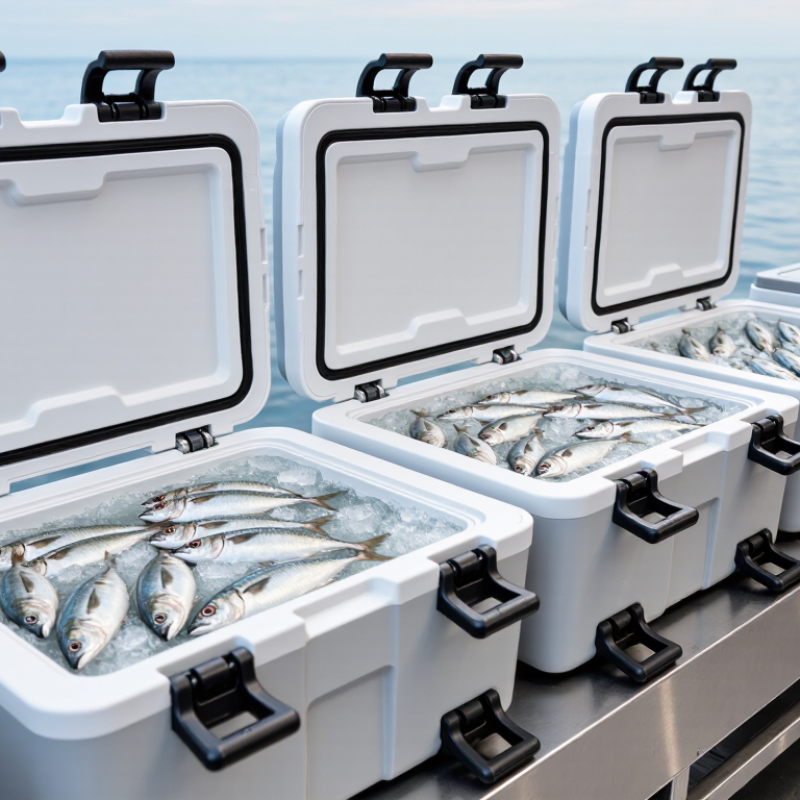
Choosing a fish box cooler starts with identifying how the catch will be handled. A hard-sided insulated cooler suits boat trips, long drives, and larger fish. Its rigid walls protect delicate fillets from crushing. Thick insulation also slows melting during hot weather. These coolers are heavy, though. That detail matters when carrying one from shore to a vehicle.

Soft-sided coolers work well for short fishing sessions and limited catches. They are lighter and easier to store under a seat. However, their insulation usually performs less consistently in direct sun. A collapsible fish box is practical for occasional use, especially when storage space is tight. It may not support heavy ice or rough handling. Check the seams, zipper, handles, and liner before buying. Small weaknesses become obvious around sharp fins.

Live-fish or bait containers need different features. They require ventilation, water circulation, or an aeration system rather than simple ice storage. Mixing these functions can harm the fish. For chilled catches, pre-cool the box and use enough clean ice to surround the fish. Keep the lid closed and drain melted water when necessary. A practical target is keeping seafood at 4°C or below. I once underestimated how quickly a half-filled cooler warmed in a parked vehicle. That mistake showed me that capacity alone is not performance. Measure the available storage space, expected catch size, and carrying distance before choosing. A convenient cooler is useless when nobody can lift it safely.

Evaluating Size, Capacity, and Portability for Fishing Needs

How to Choose the Best Fish Box Coolers?

Choosing a fish box cooler starts with the fishing situation, not the largest available model. A day trip on a small boat may need 30 to 50 liters. Longer trips require more space for fish, ice, drinks, and bait. Remember that ice takes valuable room. A box filled with fish alone will usually disappoint. I once underestimated this and had to rearrange everything on the dock. Measure your storage area before buying. Check both internal and external dimensions.

Capacity should match your expected catch, but extra weight matters. A large cooler can protect fish well, yet it becomes difficult to carry across sand or slippery ramps. Look for strong handles, balanced weight, and a lid that opens easily with wet hands. Wheels help on flat ground, but they may struggle over rocks. Portability is not just about size. It includes grip, drainage, cleaning, and how securely the lid closes during transport.

Tips: Use a measuring tape and mark your available storage space. Choose a model you can lift when fully loaded, not when empty. Pack ice around the fish, especially near the lid and corners. Drain melted water when needed, but avoid wasting cold air through repeated opening. A slightly smaller box may work better if it keeps the contents organized. My own choice would change with each trip, because weather, catch size, and walking distance are never identical.

How to Choose the Best Fish Box Coolers?

Typical cooler profiles compared by capacity, empty weight, and portability. Larger boxes hold more catch and ice, but they are heavier and less convenient to carry over long distances.

Selection guide: Choose a compact cooler for short trips and easy transport, a medium cooler for balanced capacity and portability, or a large cooler when maximum storage is more important than carrying comfort.

Comparing Insulation, Durability, and Weather Resistance

How to Choose the Best Fish Box Coolers?

Insulation controls how long fish stays cold, but thickness alone can mislead. Closed-cell foam usually resists heat transfer better than thin, loose-fill materials. The U.S. Department of Energy explains that insulation performance depends on R-value, thickness, density, and moisture. In practical use, inspect the lid seal and wall joints. Small gaps can waste good insulation. A cooler should keep contents at 41°F (5°C) or below, matching the 2022 FDA Food Code guidance for cold-held perishable foods. Use a thermometer, not your hand.

Durability matters when boxes meet wet decks, sharp fins, and repeated loading. ASTM D4169-22 evaluates shipping containers through vibration, compression, and impact testing. Those tests offer useful clues, although they do not perfectly recreate a fishing trip. Look for reinforced corners, strong hinges, replaceable seals, and a base that stays stable on uneven surfaces. Drain plugs should close firmly. They should also open without tools.

Weather resistance is more than waterproof plastic. UV exposure can weaken polymers, while saltwater may corrode fasteners and stiffen metal parts. Choose corrosion-resistant hardware and a lid that sheds rain away from the gasket. A textured surface improves grip with wet gloves. Claimed ice-retention times deserve skepticism; testing conditions vary widely. Even the best box performs poorly when opened repeatedly or left in direct sun. That is easy to overlook.

Checking Drainage, Cleaning Features, and Food Safety

How to Choose the Best Fish Box Coolers?

A fish box cooler should drain quickly after a wet, busy trip. Look for a wide drain plug that opens without tools. It should sit above the ground when the box is loaded. Meltwater trapped beneath fish can spread odor and bacteria. I test the drain with a full bucket before relying on it outdoors. That small check matters. A hose connection can also reduce mess near a dock or kitchen. Still, some plugs feel secure but clog with scales and ice. I learned this after one unpleasant cleanup.

Cleaning features deserve equal attention. Choose smooth interior walls with rounded corners and few seams. These areas are easier to scrub with warm water and food-safe detergent. Removable baskets help separate fish from dirty meltwater. They also make inspection easier. I check hinges, handles, and drain threads for slime or cracks. A cooler that looks clean may hide residue under its gasket. Do not trust a quick rinse. Scrub, rinse, and air-dry every surface before storage.

Food safety depends on temperature control and careful handling. Use a clean, calibrated thermometer rather than judging by touch. Keep raw fish cold, covered, and away from ready-to-eat food. Drain water carefully, because it may carry fish juices. If the cooler has a strong odor after washing, repeat the process. I sometimes underestimate drying time, especially in humid weather. That mistake can undo careful cleaning. Choose a box you can inspect, wash, and drain without awkward tools.

Balancing Price, Maintenance, and Long-Term Value

How to Choose the Best Fish Box Coolers?

Balancing Price, Maintenance, and Long-Term Value

A fish box cooler should protect your catch without creating daily maintenance problems. I have found that thick insulation matters most during long trips and warm weather. However, insulation alone does not guarantee value. Check the lid seal, hinge strength, drain design, and interior corners. Smooth corners reduce trapped scales and odors. A sturdy cooler may cost more initially, but replacing a cracked lid is frustrating and expensive.

Maintenance affects the real price. After each trip, rinse the box with clean water and mild detergent. Dry it completely before storage. Pay attention to the drain plug, because small debris can block it. UV-resistant materials may also reduce fading and brittleness. I once focused too heavily on capacity and ignored the empty weight. Carrying that large box became uncomfortable. That mistake still influences my buying decisions.

Tips: Compare usable space, not only advertised volume. Place a ruler beside the opening to judge fish length. Test the lid with one hand. It should close evenly without forcing it. Inspect removable parts for easy replacement. Ask about spare seals and hinges before purchasing. A cheaper model can be worthwhile when these parts are accessible. Still, low-cost plastic may warp after repeated sun exposure. Consider your fishing frequency, cleaning habits, and transport distance. Long-term value is personal, and my preferred design may not suit every boat.